

Openers
New garage door openers installed in Orange County
We replace and install LiftMaster, Genie and Chamberlain openers, with the battery backup California law requires. You get a written price before we start and a reverse test before we leave.
Open 24/7 · a person answers
Same-day on most repairs booked by 11 am.
Callback within 15 minutes
Day or night, every day.
Written price first
Nothing starts until you approve it.
CSLB Lic. #859029
C-61 / D-28 · Verify on the CSLB website (opens in a new tab)
The short answer
The short answer
Belt-drive openers are the quieter choice for garages under bedrooms, chain-drive openers suit detached garages where noise matters less, and wall-mount openers clear the ceiling for storage or high lifts. Every residential opener sold or installed in California since July 1, 2019 must have battery backup (Health and Safety Code section 19892). We install LiftMaster, Genie and Chamberlain.
Signs you need this
- The opener strains, hums or stops partway even though the door itself moves freely by hand
- There is no battery backup, so a power cut leaves the car stuck inside
- The chain slaps or the motor is loud enough to hear in the bedroom above
- Remotes or the keypad only work from close range, or not at all
- The door does not reverse when it touches an object in its path
- You want phone alerts or app control for the door
What you get
What the work includes
- Check of the door's springs, rollers and balance before the opener is fitted
- Removal of the old opener
- New opener with battery backup (HSC section 19892)
- Photo-eye sensors and wall control mounted and aligned
- Remotes and keypad programmed
- Force and travel limits set, then the reverse test (HSC section 19890)
How it works
From your call to a working door
Book or call
Book online or call (833) 366-7739. We call back within 15 minutes, day or night, and the dispatcher confirms a time window.
Inspect and choose
The technician checks the door's balance, the ceiling height, side room and outlet, then explains the drive types and features that fit your garage.
Approve a written price
You get a written price for the opener, installation and any accessories. Nothing starts until you approve it.
Install and test
We mount the opener, align the photo-eyes, set force and travel limits, program remotes and run the reverse test before we leave.
Details
Belt, chain or wall-mount
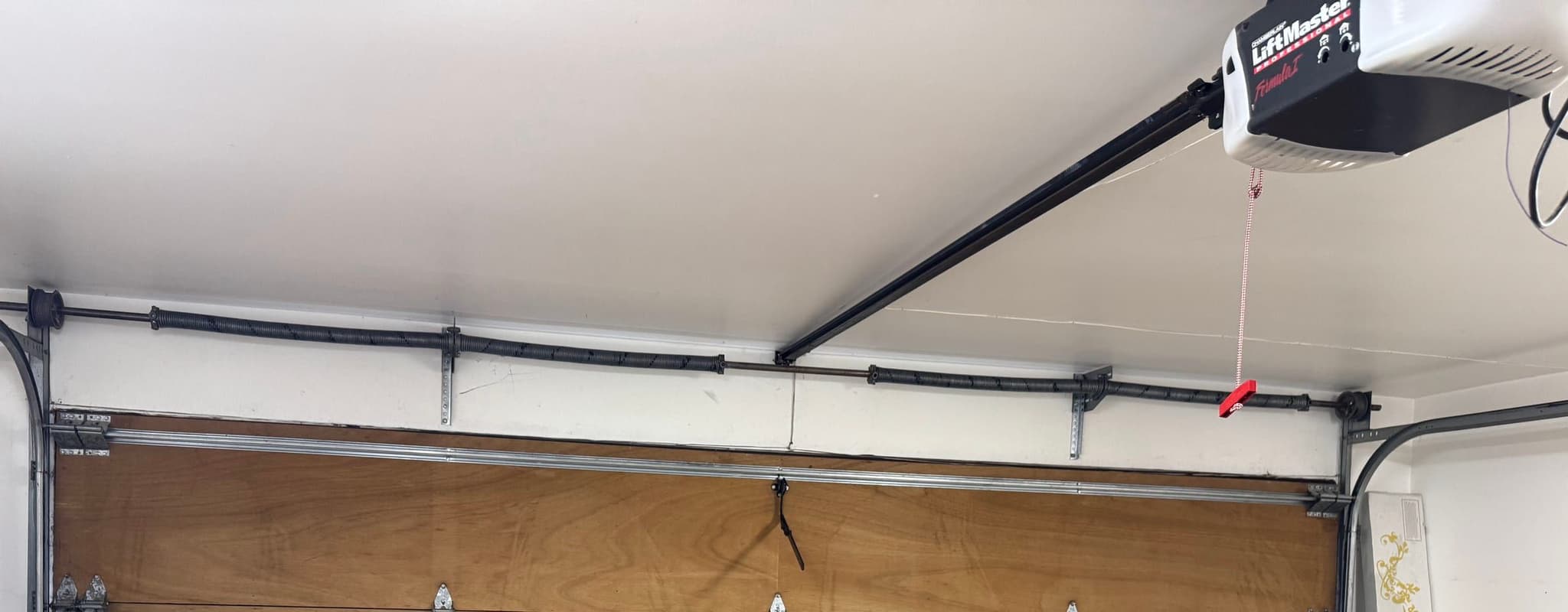
Chain-drive openers pull the trolley with a steel chain. They are durable and usually the lowest-cost option, but they are the loudest. They suit detached garages and garages with no living space above.
Belt-drive openers use a reinforced rubber belt in place of the chain. They run much quieter, which matters when a bedroom or bonus room sits over or beside the garage, so they are a sensible default for attached garages.
Wall-mount openers, sometimes called jackshaft openers, mount on the wall beside the door and turn the torsion shaft directly. With no rail across the ceiling, they leave room for overhead storage racks, high-lift tracks or a car lift. They need a door with torsion springs, enough side room and an outlet nearby, so they do not suit every garage.
Motor size matters too. A heavy wood-look or insulated double door needs more lifting capacity than a light single-layer door, and we match the opener to the door it has to move.
Battery backup and the reverse test
Since July 1, 2019, every residential automatic garage door opener manufactured, sold, offered for sale or installed in California must have a battery backup designed to work during a power outage (Health and Safety Code section 19892). Subdivision (c) goes further: a replacement garage door may not be connected to an existing opener that lacks battery backup, whatever the opener's age.
Section 19890 requires openers to reverse when the door meets an obstruction. A technician who services an opener must test it against a rigid two-inch object and, if it fails, attach a warning; a replacement door may not be connected to an opener that fails (subdivisions (e) and (h)).
For you this means three things. Every residential opener we install has battery backup. After any opener work we run the reverse test before we leave. And if you are replacing the door, the opener question is on the written price from the start, not a surprise on installation day.
Backup batteries wear out. When your opener signals a weak battery, replace it with the type the manufacturer specifies.
Smart features and which brands offer them
LiftMaster and Chamberlain openers use the myQ app, which lets you open, close and check the door from your phone and sends an alert if it is left open. Some camera-equipped models also work with Amazon Key in-garage delivery. Genie makes app-connected models as well. We confirm which app and features a specific model has before you approve the price.
Before you pay for smart features, check the Wi-Fi signal in the garage. Stucco walls and distance from the router can leave the opener offline.
Keypads and extra remotes are worth adding when several people use the garage, or when a teenager or dog walker needs access without a remote. We program every remote and keypad before we leave, and show you where the manual release and backup battery are.
An example from Irvine
Picture a two-story house in Irvine with a bedroom over a double garage, a chain-drive opener from the early 2000s and a door the owners want to replace. The chain is loud enough to wake whoever sleeps upstairs, and the opener has no battery backup.
Because the opener lacks battery backup, the new door cannot be connected to it (Health and Safety Code section 19892(c)), so the opener has to be replaced along with the door. A belt-drive opener deals with the noise. If the owners want to know when the door is left open, a model with myQ alerts covers that, and a keypad saves handing out remotes.
On installation day we would hang and balance the door first, then fit the opener, set its force and travel limits, program the remotes and keypad, and run the reverse test before leaving. The written price shows the door, the opener and each accessory as separate lines.
Price
What affects the cost
Cost depends on the drive type (chain, belt or wall-mount), motor size, smart features such as app control or a built-in camera, accessories like extra remotes or a keypad, and whether the door needs repair before an opener can run it safely. Battery backup is part of every residential opener we install. We write the price and you approve it before we start.
Can you put a new opener on my existing door?
Usually, if the door itself is in good shape. We check the springs, cables, rollers and balance first. An opener cannot fix a door that is heavy or binding, and it wears out quickly trying. If the door needs repair, that goes on the written price before the opener.
Do I have to replace my opener if I get a new door?
If your opener has no battery backup, yes: California bars connecting a replacement door to it (Health and Safety Code section 19892(c)). The opener must also pass the reverse test (section 19890). Older openers often lack backup, so we check at the measure visit.
What does the battery backup do?
It runs the opener during a power outage so you can open and close the door without pulling the manual release. How many cycles it gives depends on the model and the battery's condition; the manufacturer's manual lists it.
My door won't close on sunny afternoons. Is the opener failing?
It may not be. On west-facing garages, low sun can shine into a photo-eye sensor and make the opener think something is in the way. Shading the sensor often solves it. If the door still will not close in the shade, book a visit.
Which brand should I choose?
We install LiftMaster, Genie and Chamberlain. LiftMaster and Chamberlain use the myQ app; Genie's app-connected models use Genie's own app. We recommend a model by drive type, motor size and the features you will actually use, and price it in writing.
Related
You might also need
- Opener repairWe repair and replace LiftMaster, Genie and Chamberlain openers, reprogram remotes and keypads, and run the reverse test after every opener job. You see a written price before any work starts.
- Won't closeMost doors that refuse to close are reacting to the photo eyes, the two safety sensors near the floor. Check those first, then the remote, power and track, and leave springs and cables to us.
Open 24/7 · a person answers
Talk to a person today
Book online or call (833) 366-7739. We call back within 15 minutes, day or night.