
When a garage door in an HOA community fails, the cause is almost always one of six parts: springs, lift cables, rollers, tracks, safety sensors or the opener. Shared doors wear faster because they run far more cycles a day. Stop using any door with a gap in a spring, a frayed cable or a crooked hang.
Verified November 2026. Written for HOA boards and community managers in Orange County and the nearby Los Angeles, San Bernardino and Riverside County cities we serve.
Which doors this covers
This article is about sectional overhead doors, the kind made of hinged panels that roll up on tracks. In an HOA community that means two things: the individual garage doors on townhomes and condominiums, and the larger sectional door at a shared garage entrance.
Rolling steel doors and grilles work differently, so call us first about those. Sliding and swinging vehicle gates are different equipment again, and this article does not cover them.
Why a shared door wears out sooner
A spring's working life is counted in cycles. A cycle is one full trip of the door, from the floor to fully open and back down (Door + Access Systems, Winter 2021).
A C.H.I. Overhead Doors specification we read notes that "10,000 cycles is standard" and lists options of 25,000, 50,000 and 100,000 cycles, with "limitations based on door size and weight" (C.H.I. specification, section 08 36 00). The rating matters much more on a shared door than on a private one.
Picture a 40-home community in Irvine with one shared garage entrance. This is an example for the arithmetic, not a job we did. If each car leaves once and returns once, and the door closes behind each car, the door runs 80 cycles a day.
- A private garage at 4 cycles a day reaches 10,000 cycles in about 6.8 years.
- The shared entrance at 80 cycles a day reaches 10,000 cycles in 125 days, about four months.
- The same entrance with 25,000-cycle springs reaches the rating in about ten months.
- The same entrance with 100,000-cycle springs reaches the rating in about 3.4 years.
A rating is a design figure, not a promise. The trade association for door makers, DASMA, notes that "spring cycle life may not necessarily coincide with door cycle life" (DASMA TDS 190). Still, the arithmetic explains why a shared door that got standard springs keeps breaking them.
Two things follow for a board. Ask for the cycle rating of any new springs in writing. And count the door's cycles for one ordinary week, because that number is the best guide to which springs the door needs. We fit higher-cycle springs matched to the door.
Location matters too. The same DASMA sheet says doors near "a saline coastal location should be kept closed where possible," and that rust can cause "corrosion pits from which fatigue cracks can accelerate and reduce cycle life." That applies to communities in Huntington Beach more than to those in Brea.
The six parts and how each one fails
1. Springs
The springs counterbalance the door's weight. On a door with torsion springs they sit on a steel shaft above the opening. When one breaks, residents report a loud bang, a door that feels very heavy, or an opener that hums and gives up.
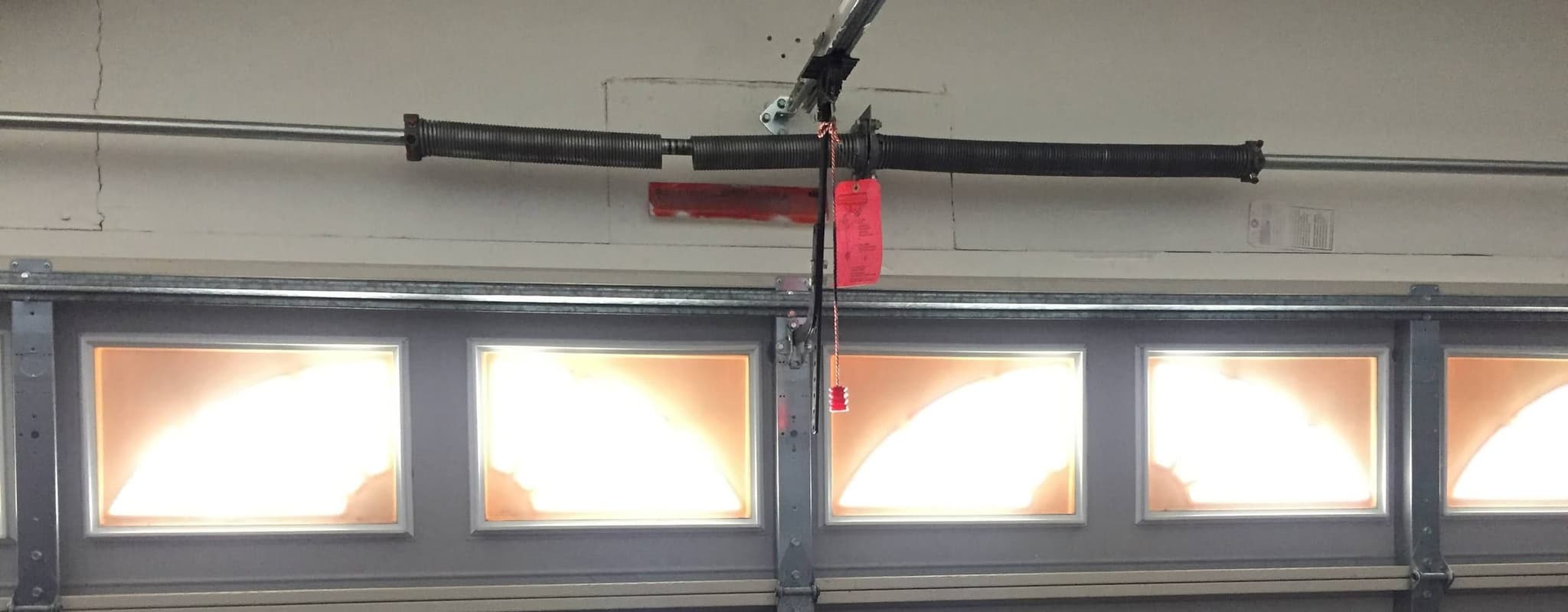
A broken torsion spring. The gap in the coil is the sign to look for.
Look for a gap in the coil. If you see one, the door stays shut and out of use. DASMA's guidance on pairs is direct: "If your door has two springs, replace both, even if one is not broken" (DASMA safety tips). More on this repair: broken spring replacement.
2. Lift cables
The cables run from the spring system to a bracket at each bottom corner of the door, and they carry the spring's tension. Broken strands, rust or a cable hanging slack on one side all mean the door should not run. If a cable lets go while the door is moving, one side can drop and the door can jam in the opening.
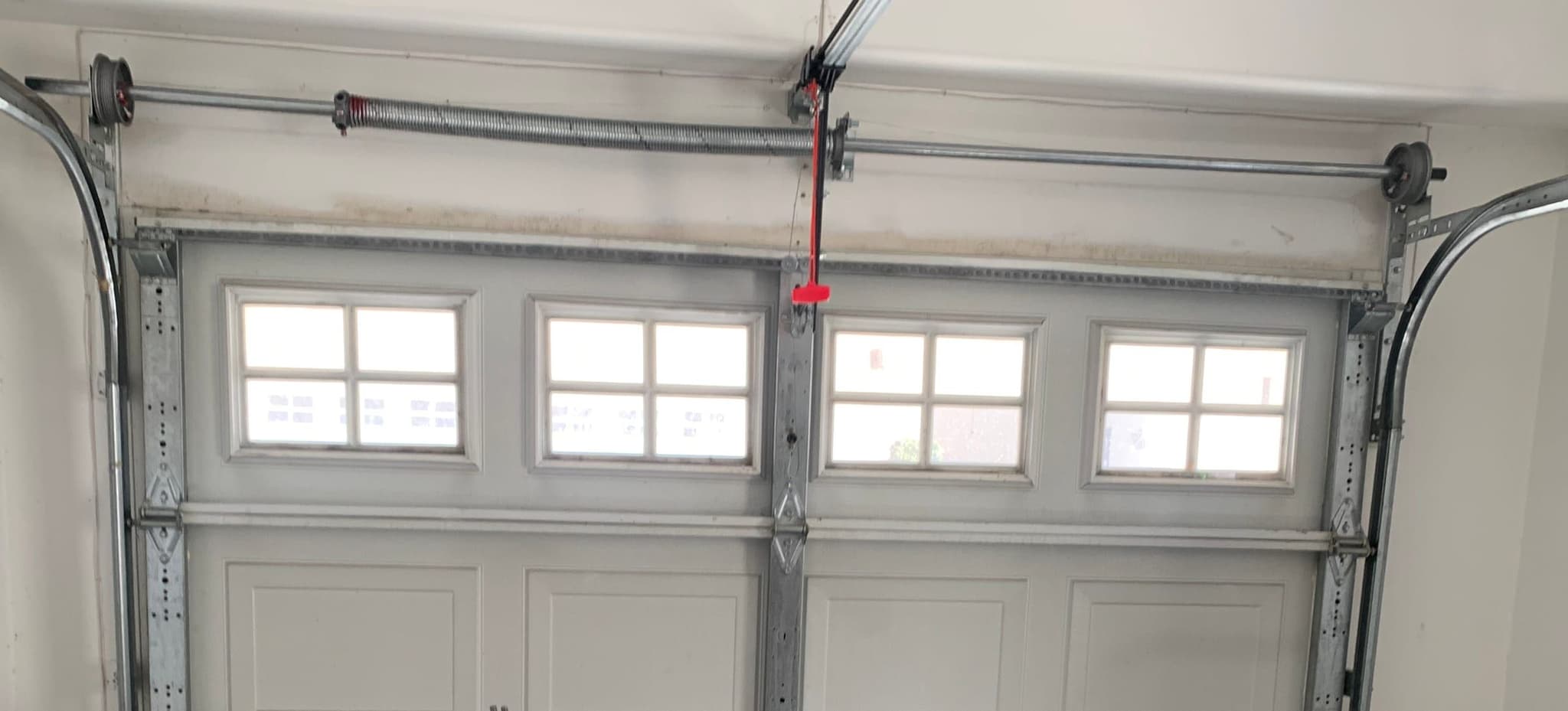
The drums at each end of the spring shaft wind the lift cables, which run down to the bottom corners of the door.
DASMA says frayed or worn cables "are in danger of breaking," and that "these cables should be replaced only by a trained technician." The bottom brackets are under the same tension, so nobody on site should loosen them.
3. Rollers
Rollers carry the door along the tracks. A roller that no longer turns drags along the track, and residents describe the door as rough, jerky or louder than it used to be.
A worn roller is a repair to book, not an emergency. A roller sitting outside the track is different. Treat that as a stop sign.
4. Tracks
Tracks guide the door. They come out of line after a bump from a vehicle, when brackets work loose, or as the building moves over the years. The usual report is a door that binds or scrapes at the same point on every trip.
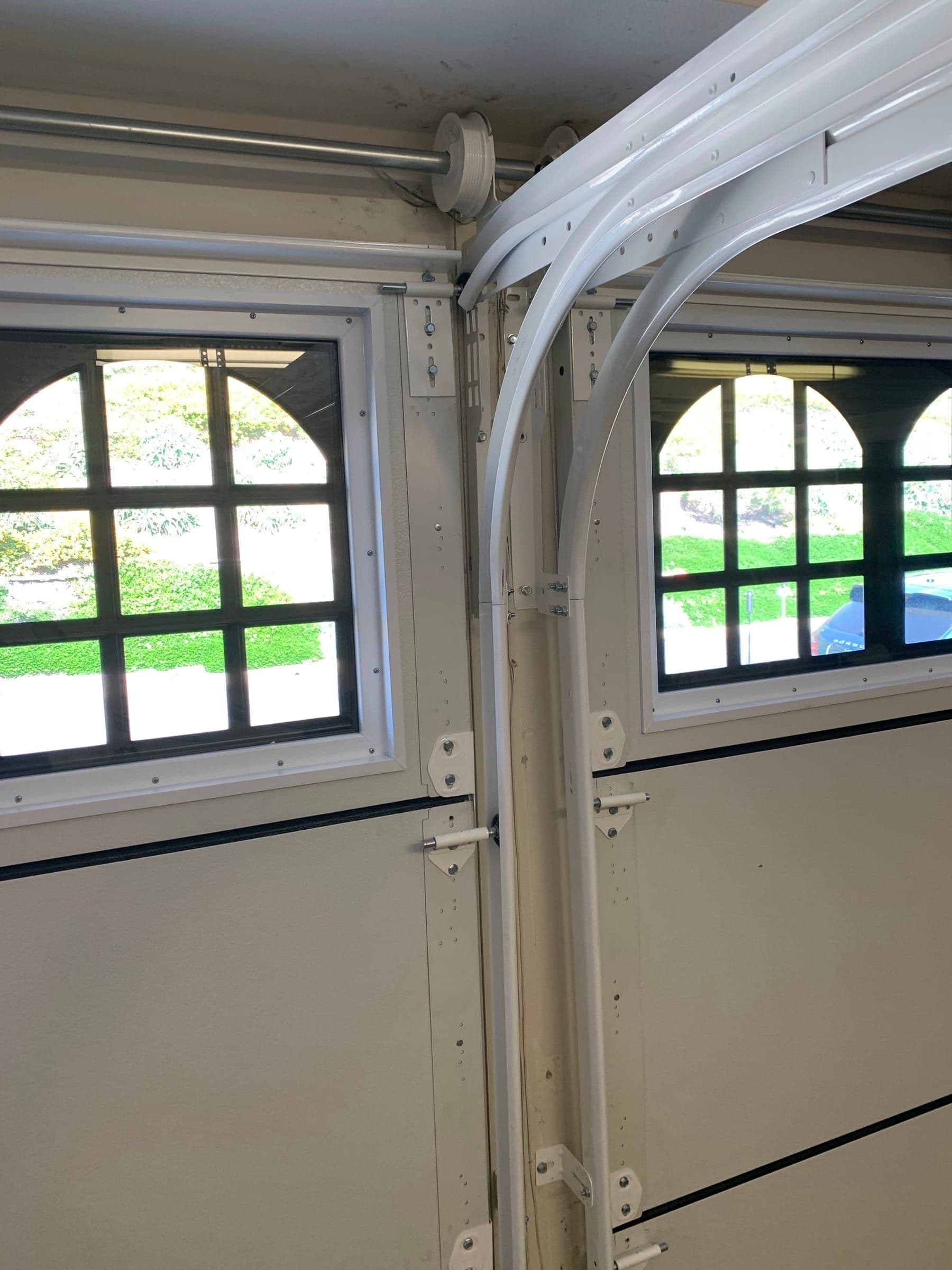
Rollers ride inside the track, which curves from vertical to horizontal above the door.
In a shared garage, vehicle impact is the cause to rule out first. If a track is visibly bent or the door hangs crooked in the opening, leave it where it is. See off-track door repair.
5. Safety sensors
The two sensors near the floor watch the opening. Since 1993, California has required residential openers to work only with a sensor or similar device, built so that "the interruption or misalignment of the device" would "cause a closing door to open and prevent an open door from closing" (Health and Safety Code section 19890(b)).
So a door that refuses to close with nothing in the way is often doing what the law intends. A sensor has been knocked out of line, or its wire is damaged. In a shared garage, sensors sit where bumpers, bikes and trash carts can reach them. Check for anything standing in the opening first, then see what to do when a garage door will not close.
6. The opener
The opener moves the door. It is not built to lift the door's weight without the springs. As springs weaken, the opener works harder on every cycle. DASMA warns that a spring system out of balance "can cause premature wear and tear on other important door components."
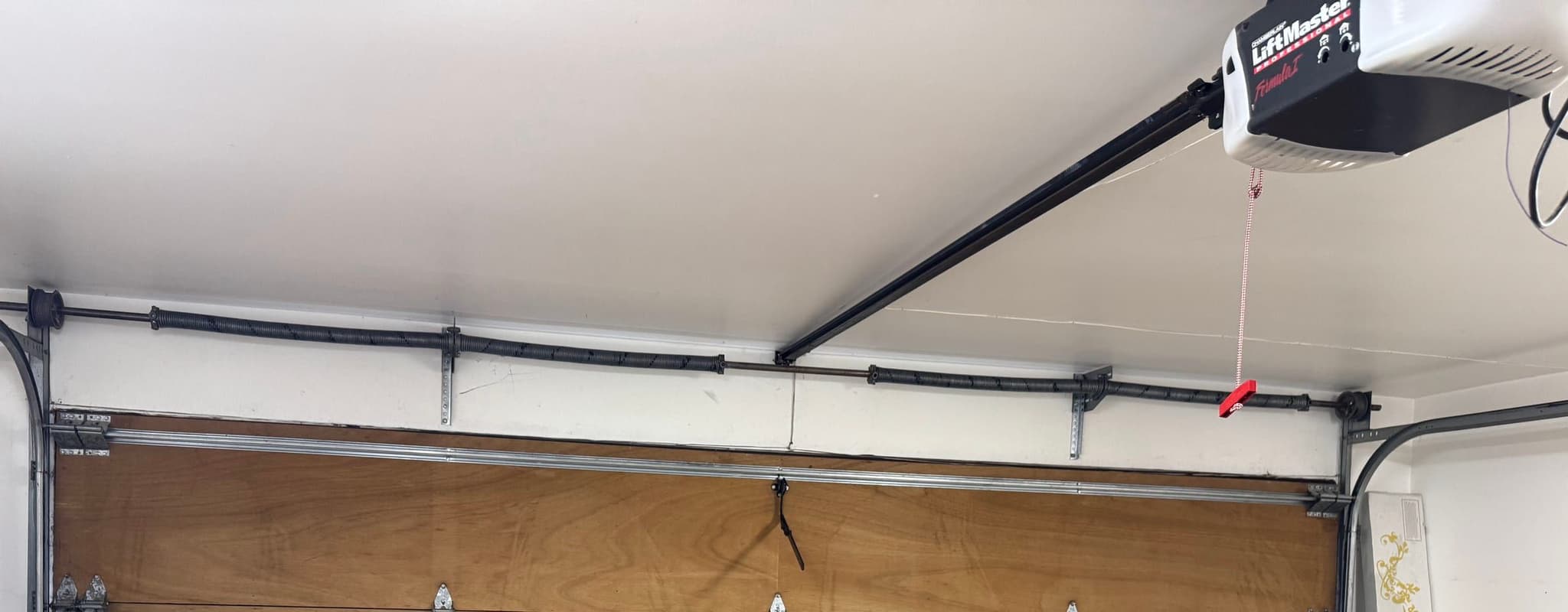
A ceiling-mounted opener and its rail, above a door with two torsion springs.
That is why an opener complaint on a busy door often turns out to be a spring problem. A tired motor, a door that stops partway or a door that reverses for no clear reason all deserve a full look at the door, not only the opener. See opener repair.
Stop using the door, or book a visit?
Take the door out of use today if you see any of these:
- A gap in a spring coil
- A frayed, kinked or slack cable
- A roller outside its track
- A door hanging crooked or sitting unevenly on the floor
- A door that closes onto an object without reversing
Keep people and vehicles clear. Do not pull on cables or force the door by hand.
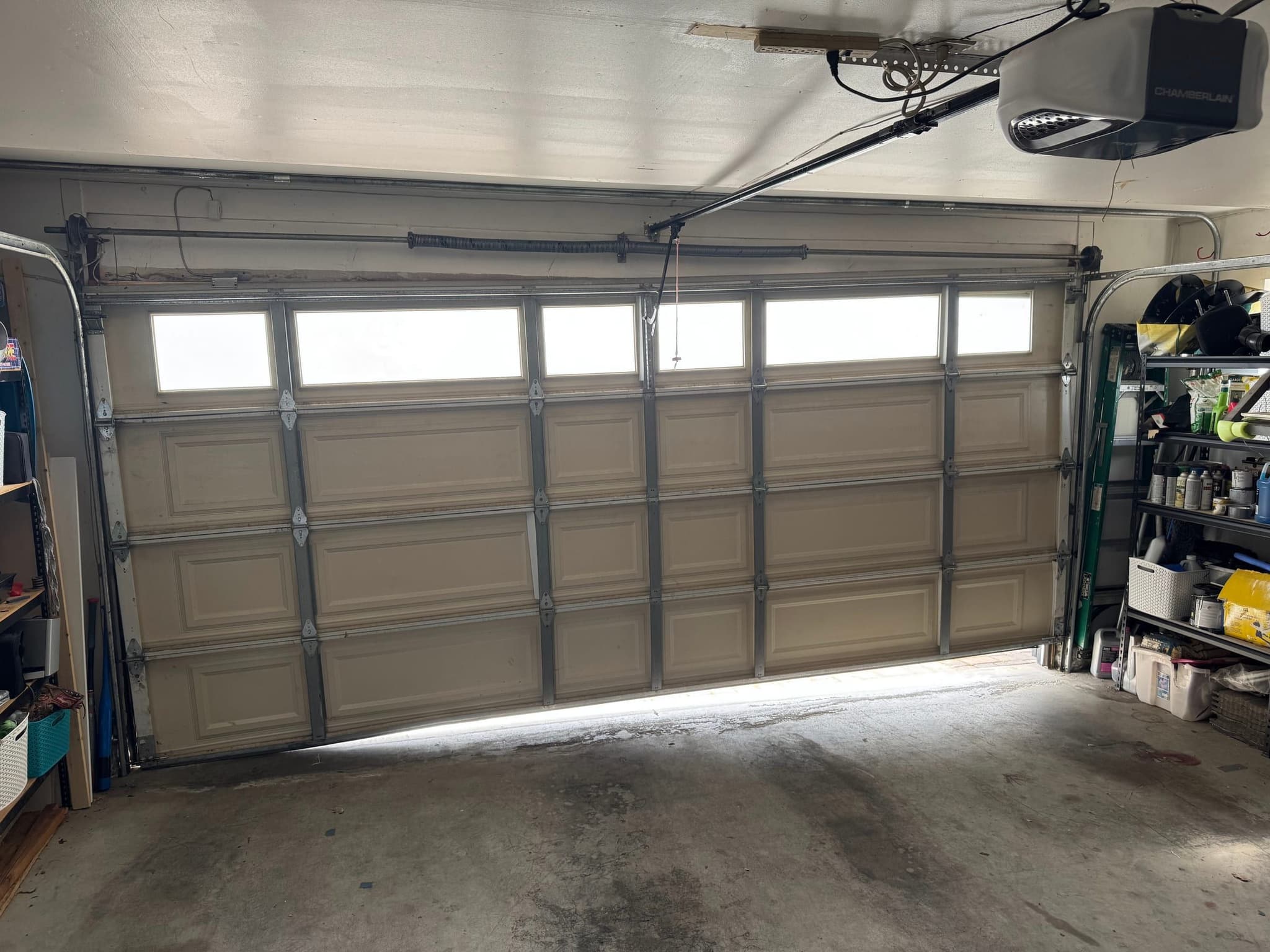
A door hanging crooked, with daylight under one side. Take a door like this out of use.
Book a visit this week for these:
- New grinding, scraping or popping noises
- A door that binds at the same point every time
- An opener that strains, slows or stops partway
- A door that will not close although the opening is clear
What to do when a resident reports a problem
- Ask three questions. Which door is it, what exactly does it do, and when did it start?
- Look without touching. From inside, with the door closed, photograph the springs, both bottom corners and both tracks.
- Check the stop list above. If any item matches, post a notice and take the door out of use.
- Check who is responsible. The declaration decides whether the association or the owner pays. The next section covers the default rule.
- Send the work order. Include the door's location, your photos, access notes and your approval limit.
- Get the price in writing. Ask for line items with a reason for each one, so the board can read it without a phone call.
- Log the repair. Record the date, the door, the part that failed, the cycle rating of any new springs, the reverse-test result and whether the opener has a battery backup.
Step 7 is easy to skip and takes two minutes. After a year, the log shows which doors fail most and why, and it gives the reserve study real dates in place of guesses.
Who pays: the association or the owner?
The default rule is in Civil Code section 4775. Each part of it starts with the words "unless otherwise provided in the declaration," so your CC&Rs come first.
- Common area. The association repairs, replaces and maintains it (section 4775(a)(1)).
- A separate interest. The owner repairs, replaces and maintains it (section 4775(a)(3)).
- Exclusive use common area. The owner maintains it, and the association repairs and replaces it (section 4775(a)(4)).
Civil Code section 4145 defines exclusive use common area. Unless the declaration says otherwise, it includes "exterior doors, doorframes, and hardware incident thereto" that are designed to serve a single unit but sit outside its boundaries.
Whether a particular garage door falls in the unit, in exclusive use common area or in common area depends on your declaration and your condominium plan. A shared entrance door serves every owner, not one unit, so read how your declaration classes it. We are door technicians, not lawyers, so have the association's attorney confirm how these sections apply to your community.
Reserve studies and board approval
Two more Civil Code sections affect garage door work.
The reserve study. Under Civil Code section 5550, at least once every three years the board must arrange "a reasonably competent and diligent visual inspection of the accessible areas of the major components that the association is obligated to repair, replace, restore, or maintain." The duty applies when those components are worth at least half of the association's gross budget, not counting reserves. If your association must replace its garage doors, ask your reserve preparer whether they are on the component list. Your repair log gives them real failure dates to work from.
Board approval. Under Civil Code section 5502, money cannot be transferred out of the reserve or operating accounts without the board's prior written approval, unless the amount is below a set limit. For associations with 50 or fewer separate interests, the limit is the lesser of $5,000 or 5 percent of the estimated income in the annual operating budget. For 51 or more, it is the lesser of $10,000 or 5 percent. A door replacement can pass that limit, which is one more reason to get a written, line-item price early.
California's opener rules and which HOA doors they reach
Two sections of the Health and Safety Code cover residential garage door openers.
Under section 19890(e), anyone hired to service or repair a residential opener must check whether it "reverses upon contact with a rigid two-inch high obstacle placed on the surface beneath the garage door." If it fails, they must fill out a red certificate and attach it to the opener where it can be seen.
Under section 19892, residential openers sold or installed since July 1, 2019 need a battery backup. A replacement door also cannot be connected to an existing opener without one, "regardless of the date of manufacture." Section 19891 sets a civil penalty of $1,000 for each opener installed or sold in violation.
Here is the detail HOA managers often miss. The chapter defines a residence as "a building that contains from one to four single-family dwelling units" (section 19890(g)). Garages attached to single homes, duplexes and fourplex townhome buildings fit that definition. A shared garage under a larger condominium building may not. Ask the association's attorney how the definition applies to your buildings.
Whatever the answer, a door that does not reverse is unsafe. We run the two-inch reverse test on every opener we work on, and we note whether each opener has a battery backup.
What a repair costs
Typical 2026 prices for a standard residential garage door, such as the door on one townhome or condominium garage:
- Service call and diagnosis: $85 minimum, plus parts
- Most common repairs: $175 to $195
- Opener repair: $85 to $395. The average is about $125, and complex electronics run about $250.
- Spring replacement on a standard two-spring steel door: $195 to $495 for both springs
- Spring replacement on a heavy carriage-house door with industrial springs: $1,300 to $2,300
- Cables, rollers, panels and off-track repair: priced in writing before work starts
Prices verified November 2026. These are typical ranges, not a quote. Your exact price is given in writing before any work starts.
We do not print a price list for shared entrance doors. Their size, their weight and the spring rating they need decide the parts, so each one is priced after an inspection.
Whatever the door, the order of events is the same. The technician inspects the door, explains what failed and gives you a written price. Nothing starts until someone on your approval list accepts it. If you give us a not-to-exceed amount, work stops for approval when a repair would go over it.
Frequently asked questions
How often should community garage doors be inspected?
DASMA recommends monthly safety checks by the owner and says "an annual visit from a trained door systems technician can keep your door operating safely and smoothly for a long time." Treat once a year as the floor. A shared entrance that runs dozens of cycles a day earns more frequent visits. See what a maintenance and safety inspection includes.
Can our on-site maintenance staff fix a garage door?
Staff can look, photograph, clear anything blocking the opening and take a door out of use. Springs, cables and the brackets at the bottom corners are not staff work. DASMA says spring systems "are dangerous and should be repaired only by trained professionals."
A door will not close and nothing is in the way. Is that urgent?
A sensor knocked out of line is a common cause, and the opener is built to keep the door open when that happens. But an open garage is a security problem for every resident, so book it the same day you hear about it.
Do you work on HOA and shared garage doors?
Yes. We repair residential garage doors and openers in HOA communities and shared garages. For commercial rolling steel doors, call (833) 366-7739 first and ask.
Set up your community's doors with one vendor
DoorsEZ handles garage door work orders for HOAs and property managers from our Fullerton base. Every job gets a written price before work starts, and your work orders are tracked online so the office can see where each one stands. See the program for property managers and HOAs, or call (833) 366-7739.
About this article. Written by the DoorsEZ team and checked against the sources listed below. DoorsEZ is a brand of A Quality Garage Door Company, a family-owned garage door business since 1962, based in Fullerton. CSLB Lic. #859029 (C-61 / D-28). Verified November 2026.
Sources
- DASMA, Safety Tips for Garage Doors (springs, cables, bottom brackets, balance, annual service); read 2026-11-23 (opens in a new tab)
- DASMA Technical Data Sheet #190, Factors Affecting Spring Cycle Life; read 2026-11-23 (opens in a new tab)
- Roy Bardowell, Enhance Your Business by Understanding the Garage Door Cycle, Door + Access Systems, Winter 2021; read 2026-11-23 (opens in a new tab)
- C.H.I. Overhead Doors specification, Section 08 36 00, Model 3295 (spring cycle life options); read 2026-11-23 (opens in a new tab)
- California Civil Code section 4775 (who repairs, replaces and maintains); read 2026-11-23 (opens in a new tab)
- California Civil Code section 4145 (exclusive use common area); read 2026-11-23 (opens in a new tab)
- California Civil Code section 5550 (reserve study and visual inspection); read 2026-11-23 (opens in a new tab)
- California Civil Code section 5502 (board approval of transfers); read 2026-11-23 (opens in a new tab)
- California Health and Safety Code section 19890 (reverse test, sensors, definition of residence); read 2026-11-23 (opens in a new tab)
- California Health and Safety Code section 19891 (civil penalties); read 2026-11-23 (opens in a new tab)
- California Health and Safety Code section 19892 (battery backup); read 2026-11-23 (opens in a new tab)